The Invisible Cost of AI: Data Centers, Water, and Scale
The Myth of the Cloud
Listen... when we talk about AI, we use words like "the cloud," "neural networks," and "virtual agents." These words are designed to make the technology sound weightless, infinite, and entirely digital. But that doesn’t make sense, and here’s why.
There is no cloud. There are only massive, hyper-industrialized data centers eating up physical space, pulling an astonishing amount of electricity off the grid, and consuming millions of gallons of water every single day just to keep their servers from melting down.
The Scale of the Problem
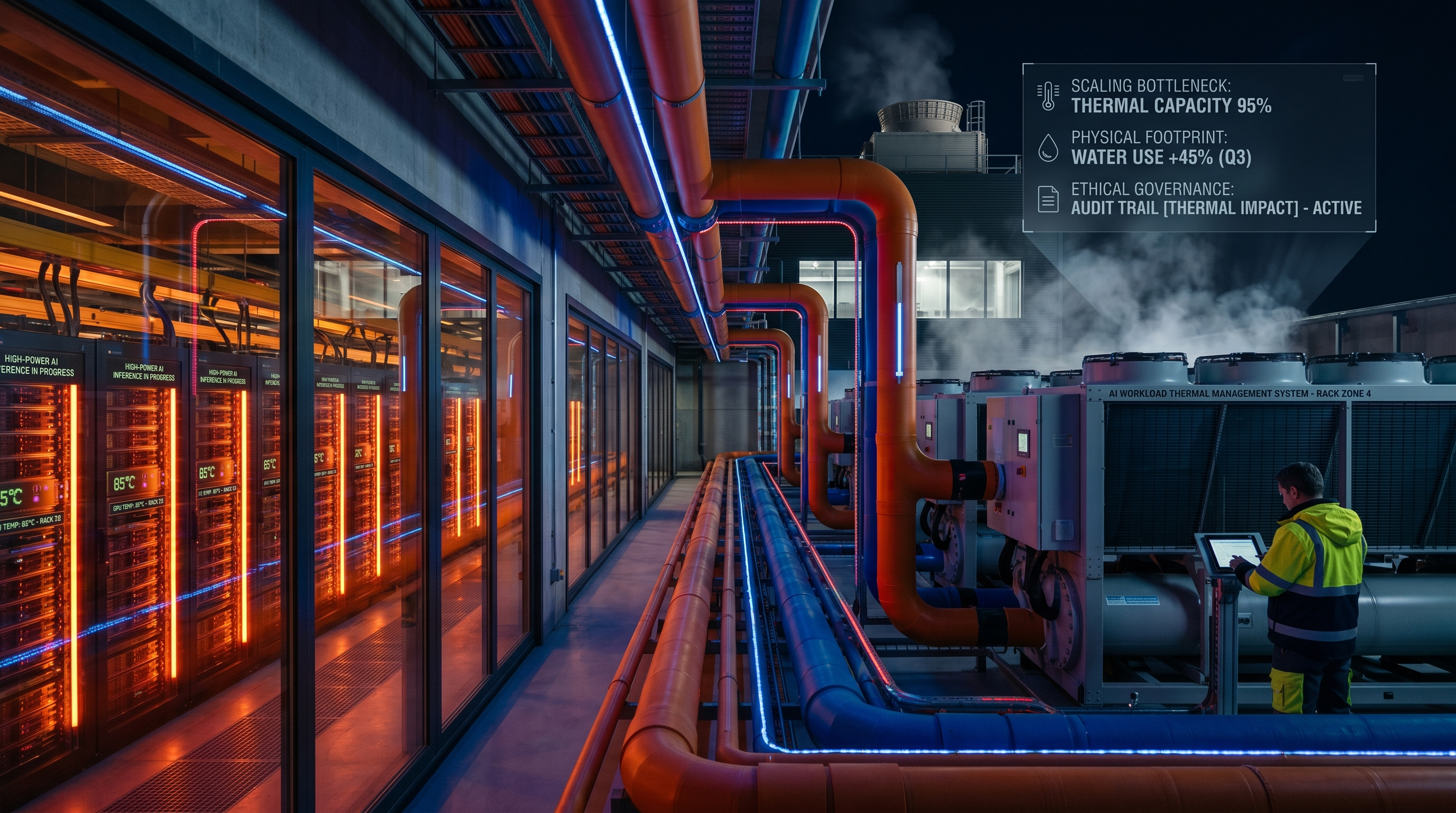
Every time an AI model generates an image, summarizes a pdf, or runs an agentic workflow, a physical machine somewhere on earth has to work hard enough to generate heat. And that heat has to be cooled. You follow what I mean?
When organizations try to scale their AI pilots—which a staggering 95% of them fail to do successfully—they aren't just hitting a software bottleneck. They are hitting a physical infrastructure bottleneck. If we are going to build ethical, governed systems, we cannot ignore the physical footprint of the tools we are relying on.
Governance Must Include Infrastructure
I'm just saying... as founders and clinicians, my license could be on the line when I deploy these systems. We have to look past the pretty interfaces and the slick SaaS marketing. True AI governance (the S.A.G.E. Framework: Secure, Agentic, Governed, Ethical) means understanding the supply chain of your intelligence. If you are building high-trust digital architecture, you need to know exactly how much energy your tools are demanding, and whether that scale is actually sustainable for your practice—and the planet.
We’ll circle back to that in future posts as we look at how to build leaner, more efficient AI agent systems that don't require boiling the ocean just to answer a patient's FAQ.
References & Further Reading
·MIT Project NANDA — The GenAI Divide: State of AI in Business 2025 Challapally, A., Pease, C., Raskar, R., & Chari, P. (July 2025). The study behind the 95% statistic. Full report available at:mlq.ai/media/quarterly_decks/v0.1_State_of_AI_in_Business_2025_Report.pdf
·MIT report: 95% of generative AI pilots at companies are failing: fortune.com/2025/08/18/mit-report-95-percent-generative-ai-pilots-at-companies-failing-cfo
·Environmental and Energy Science Institute (EESI) — Data Centers and Water Consumption Covers the 211 billion gallon indirect water footprint of U.S. data centers in 2023 and projected consumption through 2030. eesi.org/articles/view/data-centers-and-water-consumption
·World Economic Forum — How Data Centres Can Avoid Doubling Their Energy Use by 2030 Documents that the average data center consumes 300,000 gallons of water per day and that global data center electricity consumption reached 415 TWh in 2024 with projections to nearly double by 2030. weforum.org/stories/2025/12/data-centres-and-energy-demand
·Lincoln Institute of Land Policy — Data Drain: The Land and Water Impacts of the AI Boom Documents AI hyperscale data center energy and water demands, including individual facility comparisons to entire cities. lincolninst.edu/publications/land-lines-magazine/articles/land-water-impacts-data-centers